
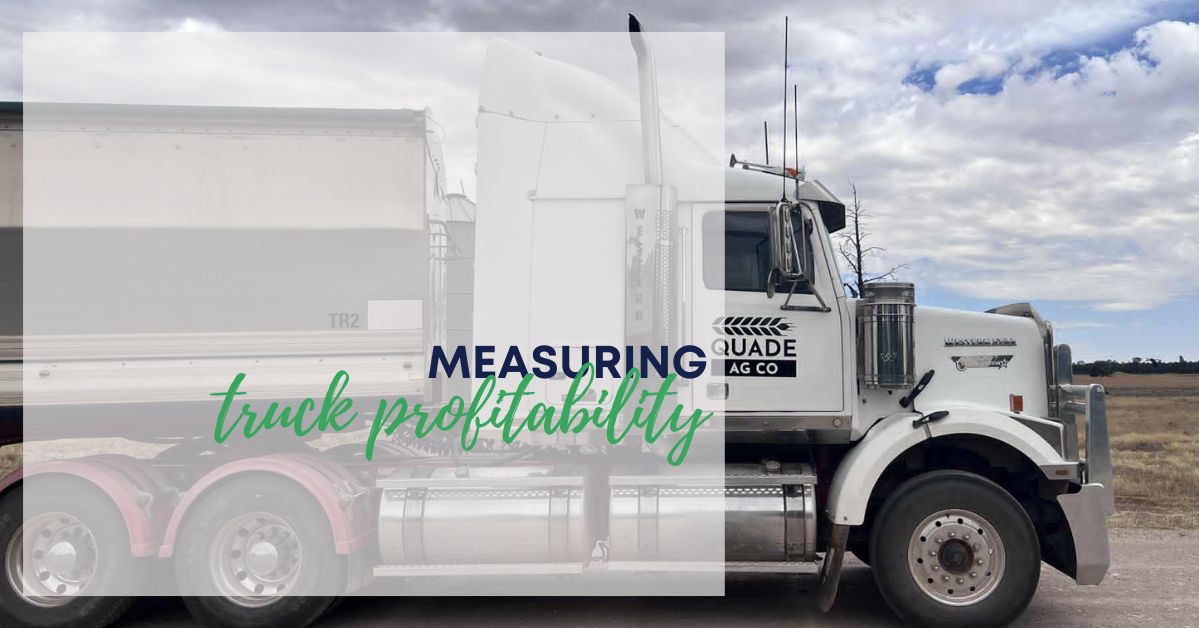
Or are they costing money, and are contractors a good alternative?
Conventional accounting methods in enterprises with trucks tend to overinflate grain prices, pool truck and trailer repairs in with other paddock based equipment and under cost inputs like fertiliser, lime and gypsum that you may be transporting yourself.
You should be able to easily isolate the cost of production and returns from grain growing as well as the contribution to profit made by running trucks.
To do these calculations you need some information. We need to track both income (or costs saved) and expenses related to the truck.
Tracking Expenses
There are a few different options for tracking costs and it is something you might want to discuss with your accountant. Costs can be tracked in general ledger codes, however this can result in a crowded general ledger as there are many items that will need to be duplicated for each truck you wish to track. For example, you would have to set up a code for each truck’s registration, repairs, fuel, insurance etc. You could sort through receipts and invoices at the end of the year, or as you go, and add them to a separate spreadsheet.
Alternatively, your bookkeeping program may have a cost tracking feature that is worth exploring –
In Xero – Have a look at tracking categories. This allows to you allocate expenses to one of two master categories and then allocate up to 100 category options.
In MYOB – Look at jobs
In Phoenix – Have a look at enterprises or sub categories
At the end of the year or season, you should be able to produce a report that outlines all the direct costs associated with the truck – registration, tyres, insurance, tyres, repairs, tyres, maintenance and upgrades.
To keep things simple, I like to treat the truck and the associated trailers as one unit. This is especially important if you have more than one truck, and each truck has multiple trailers. Treating the truck and trailer as one unit reduces data entry and makes reports easier to read.
What’s relevant and how to record it?
Tracking fuel costs – This can be hard. You may be filling from on-farm unmetered bowsers as well as on-road metered fuel. If you have an existing system tracking fuel use for trucks for the purposes of Fuel Tax Credits it may be used here. If you can’t record truck use of on farm fuel to a good approximation of litres, it may be easier to examine litres/km and make a reasonable estimation that way for fuel use on an annual basis. Same goes for Add Blue and oil. It’s ok to use average prices, it’s not likely to make a huge difference to the end result.
Calculating Depreciation – Tax related depreciation uses a set deprecation rate. The reality is that trucks and trailers depreciate at rates that follow a different pattern and percentage than what the ATO prescribe. When we are making management decisions, we need to use management figures. So, for the purposes of this type of analysis, use the loss in market value of the truck and trailers over the year as your guide. For older trucks that are lightly used, in some years it may be negligible.
Interest or cost of ownership – From an accounting perspective, some people would recommend looking at the payments on a loan as a factor in decision making. This is certainly a consideration when looking at cash flow for a new investment decision. However, even wholly owned items are claiming a spot on the balance sheet and that comes at a cost. The reality is, if you have debt on anything, you have debt on everything. What do I mean?? If you have all your trucks and machinery paid off, but a $2,000,000 term loan on your farm at 6%, the value tied up in your machinery could be alternatively allocated to the debt and cut your interest bill by 6%. If you had no debt the money could be invested in the stock market and earn a higher return. Use a figure relevant to you to determine how much it is costing you to have capital tied up in this decision, rather than another.
Wages – For paid employees allocate the hours spent driving, loading and maintaining the truck. As an owner operator try to calculate the hours spent on both driving and maintenance. An app like WorkHours can be used to track hours across enterprises. Essentially your time spent in any business is selling hours of your life. You only have a limited number to sell; in a week, a month, a year or a lifetime. You have to make sure the hours you are selling are making a worthwhile return. It may be behind the wheel, or it may not. In our 2025 survey of rates of pay for harvest work, casual HR drivers averaged $42 an hour and casual MC drivers averaged $45 an hour. Add 15% to the relevant rate to take into account super and workers comp costs.
Set Up Costs – A new truck to the business might also have stamp duty and set up costs to consider. From a cash flow perspective they need to be included in the annual costs. From an ongoing basis it’s probably best to consider them as a part of the total purchase cost and subject to an overall decline in value.
Tracking the value added by carting grain
Equalising all grain sold to a farm gate price makes it easier compare pricing, especially if you are also storing grain and it is going to a number of different locations across the year. For transport of your own grain, calculate the value of the contract transport alternative.
There are a few ways to capture this information.
a) Deduct the cost of commercial freight from every delivered tonne and allocate it to a freight recovery or freight component account code. If the rate varies across the year from peak rates at harvest time to a lower rate, alter the rate at different times of year. There is a Xero example below, however have a chat to your accountant about the best way to capture this information. If you use a mixture of your own and contracted trucks, just remember to net off this figure against the external freight paid to determine how much freight income has been earned by your own trucks or offset by others.
b) Track truck movements for on farm storage – For simplicities sake, just ignore small trips to seed silos etc. If you are storing significant tonnages in on farm storages, and some are quite a distance from the paddock it is worth tracking these loads. A google form, a weighbridge diary or a grain tracking app can help here. However, using big numbers for calculations at the end of a season is ok too. For example, you have 10,000t stored on farm and you are using three trucks roughly equally that carry 40t. That is 250 loads in total. Each truck does about 1,000km each harvest from various points of the farm and lease blocks to different silos or bunkers. With each load averaging 12km return you might estimate a commercial equivalent at $8-12/t. The total commercial equivalent being somewhere between $80,000 and $120,000 per year for the three trucks.
c) Use a ticket list from your bulk handler – Your online portal will give you a ticket list with the truck registrations. A quick pivot table will show you how to sort this information out at the end of the season. If the truck is also used to provide freight for others, it is easy to allocate this income to the vehicle. If you do a range of contracting jobs with different machines, separate codes or subcategories may make it easier to extract this information from your reports.
Track the costs saved by carting inputs
Tracking the cost saved by carting other inputs, like lime, gypsum, fodder or fertiliser into your account codes is straightforward if you are set up correctly.
Make the decision to use the landed cost for fertiliser in your P&L. If you buy fertiliser or other inputs, use the landed cost, including freight in the account code, even if the freight is listed separately on the invoice. If you have carted some or all loads yourself, add the cost of the freight (at commercial terms) to the general ledger code for the input, then deduct the same amount and allocate it to your freight recovery income account.
Making Decisions…..
t the end of the equation, you will be left with a figure in the surplus or deficit box.
In really simple terms a positive figure means that your truck “enterprise” is making a profit, a negative may mean it is losing you money.
However, there are a few considerations.
Convenience – Like the girl with the little curl, truck drivers can also be very very good or horrid. If you have had a few horrid experiences, the convenience that comes with having your own truck in your own shed where you left it and loading it when it suits you may be worth a lot to you in time and stress saved. The figure you generate in the above equation helps with this. You may say to yourself, “I am happy losing $15,000 on a truck each year to save myself a bit of hassle”, alternatively if the cost is $30,000 a year you might be willing to put up with a little mucking around with curly headed blokes and their trucks. Though dollars are a consistent unit of measurement, they mean different things to different people.
Availability – The availability of trucks for grain carting, particularly at harvest time, varies from region to region, and within the same region, from year to year. The need to get the job done in a timely fashion may mean you are happy to accept a lower level of return or even run a truck at a loss, so the entire harvest operation can run smoothly.
Paying yourself – In this example we allocated a casual hourly rate to the owner operator. It’s the correct way to do it, however if those hours cannot be allocated elsewhere for increased profitability in another part of the business, or in off farm work, the overall profitability of the business would fall if the truck was not run. Some businesses may be at the stage of the family farming business lifecycle where there is a surplus of labour. In this case, making a small surplus or loss on the truck after accounting for internal wage costs on running a truck might be ok, especially if the same labour hours cannot be deployed elsewhere for a better return.
Commercial terms – The comparison figure we used for freight carted was the commercial term. Your running costs may well be more or less than this, corrupting the equation and making the returns from the truck seem higher or lower. Look at your expenses from the exercise above and see how they compare to the commercial terms on a per load or km/t basis.
Expensive or cheap grouper – Trucks may not just be used for harvest or for carting grain. They may also be used at sowing time. The presence or absence of a truck at sowing time may have implications for sowing logistics. Knowing the profitability of the truck enterprise may lead to better decisions. If labour is available is it more profitable to buy an old truck and a grouper for sowing time and keep the main trucks and trailers running through the year?
Realise your limitations – To maximise the proportion of the crop that is carted in your truck or trucks and have a smooth-running harvest you may need to upgrade in paddock or on farm storage and increase casual labour hours. That’s another set of sums, make sure that adds up too. Chris Minehan from Rural Management Strategies noted that there are often opportunities to capture in the paddock that increase production that are easily missed. He suggests to his clients “Be sure all the low-hanging fruit at production level is picked, before worrying about running trucks down the highway, as it can be a major distraction for a small-scale family operation”
What levers can you move?? – Now you have the information in a spreadsheet, have a look to see what factors can be moved to change the equation. Doing more loads, increasing capacity with larger trailers or registration changes to carry more tonnes per load. Does the profitability of the enterprise justify an upgrade or a downgrade of the prime mover or trailers? Can outside loads justify the cost of registration on commercial rather than primary producer rates.
It’s complicated – Some businesses are at a level of scale and complexity where simple calculations don’t make sense. Where grain storage and marketing are important parts of a grain growing operation, trucks may not be able to be looked at in isolation as they could be an essential part of market access. If this is the case, you don’t get out of doing your sums, you just have to do a few more. There are plenty of people that can help with this sort of work if needed.
What about tax?- To use a Harry Potter analogy, accountants are magical, you are a muggle. Do the sums above and show the magician in your life so they can sort the tax out. Talk to them before you make any changes to how you record or collect this information if you are doing it within your bookkeeping system so you don’t make any unintended mistakes.
Acknowledge that truck driving is not an overly appealing job to a lot of people – It’s one thing to cart your own grain in your own truck for a month or so during the festival of harvest, it’s another thing to do it year round. Attracting and retaining staff relies on being a good boss, but that only gets you so far. Good wages and a good truck are also needed, both of which could impact on your enterprise profitability. The least profitable truck is the yard ornament that does not move due to a lack of a driver, so again, do your sums. I think there is great potential in this space for joint venture arrangements with keen up and coming owner operators who share the capital outlay and profitability of truck with a farm business.
Tech and Logistics – New trucks have options for new technology such as vehicle tracking devices. On newer trucks they calculate the fuel use, km driven, hours etc and link in with other paddock managment apps.
Choosing what you want most
There are endless opportunities for any dollar or hour invested in a farming business or in life in general.
Sometimes the choice comes down to what you want to do. The struggle is determining what you want most.
It’s useful to look at these sorts of internal investment decisions on the basis of return and it’s ok to look at economic and non-economic factors.
All decisions have a trade-off.
A higher investment in a truck may generate great returns but come at the cost of family time.
A high investment in a truck may generate great returns that can be reinvested in other profitable infrastructure or debt reduction.
A loss-making truck might be justified because of ease of harvest operations and input procurement within a business that is profitable overall.
A reliable old girl may generate great internal returns and poke along happily.
This old girl may continue to poke along until you have to convince someone under 40 or over 60 to drive it. Every truck gets to the point where cost of repairs and eventually registration becomes an issue.
Do the numbers, they help.
All farm businesses are different;
All farming families are different.
Use the numbers to be confident in your own decision making and to help you when things change.
Download a printable copy of this article with templates to add in your own figures
Share the love
[Sassy_Social_Share]
